

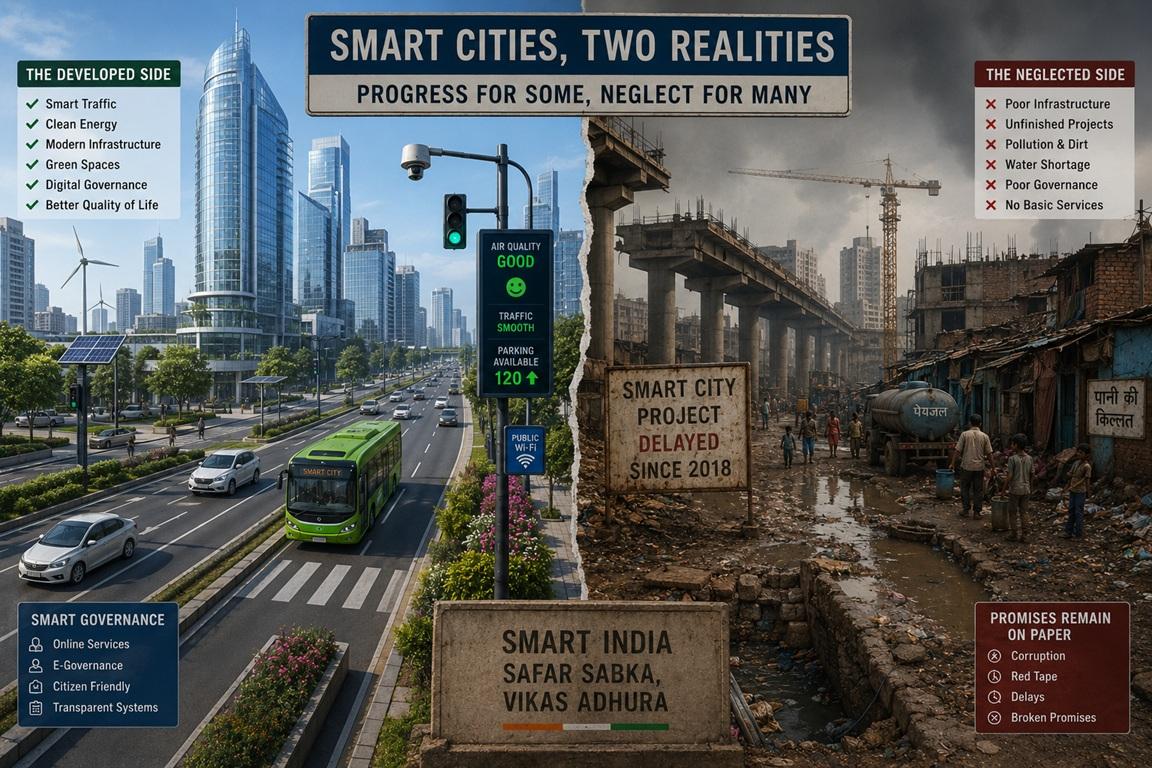
Indian Smart cities - An Urban Dream or a Decade of Missed Opportunities?

editor
Editor: WhiteAnalyst

Audio Podcast:  

26 June 2026 | 7:46 am

Highlights

  • On May 2026 - Water crisis in Mumbai , As it has 45 days of water left ? 
  • India 6th most polluted country in the world according to World Air quality report.
  • Potholes related road fatalities increased by 53% in 5 years.
  • Under Smart cities Project - Instead of transforming entire cities, investments were concentrated in small pockets & struggling to provide basic amenities to its citizens.
  • Public Accounts Committee (PAC) flagged severe structural gaps across government hospitals, highlighting massive overcrowding and acute shortages of basic medical equipment.

post image

Imagine living in a city that knows everything about you. It knows when you leave for work, which route you take, how much water you consume, where traffic will build up before it even happens, and even when your neighbourhood’s garbage bins need to be emptied. Sounds like the future, doesn’t it?

Ten years ago, India promised exactly that future. In June 2015, the Government of India launched the Smart Cities Mission with an ambitious dream—to transform 100 cities into cleaner, safer, technologically advanced, and sustainable urban centres. It was a bold attempt to answer a pressing question: How do we make Indian cities liveable in the twenty-first century?

At a time when millions of Indians were battling traffic congestion, pollution, poor waste management, shrinking public spaces, and crumbling infrastructure, the mission was welcomed with immense optimism. It was not merely an urban development programme; it was a promise that cities could become engines of opportunity rather than symbols of chaos. A decade later, however, the excitement has given way to a more complicated reality. Yes, cities have become smarter. There are command centres, thousands of surveillance cameras, intelligent traffic systems, smart classrooms, and digital services. Yet, millions of citizens continue to struggle with the same fundamental problems they did ten years ago. The contradiction is impossible to ignore. 

How can a city be called smart if its citizens still struggle to access clean water, affordable housing, and safe public spaces?

Perhaps the real question was never whether India could build smart cities. Perhaps the real question was whether India understood what a smart city truly meant. Ten years after its launch, the Smart Cities Mission deserves more than a progress report. It deserves an honest conversation. Was it a transformative urban revolution or a decade of fragmented ambitions, missed opportunities, and expensive experiments? The answer lies somewhere in between.

A Grand Vision Without a Clear Definition:

Perhaps the mission’s biggest contradiction existed from the very beginning. No one clearly defined what a “smart city” was supposed to be. The official mission document itself admitted that there was no universally accepted definition and that every city could interpret the idea differently. While flexibility may appear progressive, it also created confusion. Without a common framework, implementation became fragmented. In many cities, projects emerged as isolated interventions rather than components of a larger urban vision. The result was a patchwork of unrelated projects—from beautification drives and recreational facilities to road upgrades and surveillance systems—without a clear answer to one simple question:

How exactly would these projects make cities more liveable?

A smart city cannot be measured by the number of cameras installed or roads constructed. It must be measured by the quality of life it creates. The Numbers Tell a Mixed Story The Smart Cities Mission was originally designed to be completed within five years. Since the 100 cities were selected between 2015 and 2018, implementation timelines were spread between 2019 and 2023. However, the deadlines kept shifting.

First, the mission was extended to June 2024. When that target was missed, the government announced another deadline of March 31, 2025. Even after a decade, the story remains unfinished.

According to the Smart Cities Mission dashboard, as of March 4, 2025: 7,504 projects (93%) worth ₹1.5 lakh crore have been completed. 559 projects worth ₹14,239 crore remain under implementation. Only 18 out of 100 cities have completed all their projects. Cities that have successfully completed their projects include Agra, Varanasi, Madurai, Coimbatore, Udaipur, Pune, Surat, and Vadodara, among others. This means that 82 cities still have unfinished projects despite a decade of implementation. The question is no longer whether progress has been made. The question is whether the pace of progress justifies the scale of investment. 

Success Stories Exist. But They Are Not the Whole Story.

To dismiss the Smart Cities Mission entirely would be unfair. Several achievements deserve recognition. Today, all 100 smart cities have Integrated Command and Control Centres (ICCCs), enabling real-time monitoring and data-driven decision-making. More than 84,000 CCTV cameras have been installed to improve public safety. Over 17,000 kilometres of water pipelines are monitored through advanced systems to reduce leakage and improve efficiency. More than 66 cities have adopted technology-enabled waste management systems.

Urban mobility has also improved through: 1,740 kilometres of smart roads.713 kilometres of dedicated cycling tracks. Intelligent Transport Management Systems. The mission has also entered classrooms and healthcare facilities through: 9,433 smart classrooms, 41 digital libraries, 172 e-health centres,152 health ATMs. These are meaningful achievements. Yet they also expose the mission’s central dilemma. Infrastructure has improved faster than inclusion.

The Problem of Building Smart Islands:

One of the most criticised aspects of the mission is its Area-Based Development model. Instead of transforming entire cities, investments were concentrated in small pockets. Certain roads, markets, or commercial districts became showcase projects, while surrounding areas continued to struggle with poor infrastructure. In effect, cities developed two parallel realities. One technologically advanced.The other is still waiting for basic services. The danger is obvious. India risks creating smart islands inside struggling cities. Urban transformation cannot be selective. A truly smart city must improve the lives of all residents, not just those living in designated zones. 

When Technology outpaces democracy another criticism concerns governance. To speed up implementation, Special Purpose Vehicles (SPVs) were created to execute projects independently. Most SPVs are headed by CEOs appointed by state governments, while elected local bodies often play a limited role. While this structure improved administrative efficiency, it weakened local accountability. Cities are not corporations. They are democratic spaces. Urban planning cannot become a top-down exercise where decisions are made inside command centres while citizens remain passive spectators. Perhaps the mission underestimated a fundamental truth: The future of cities cannot be designed without the people who live in them.

The Corruption Question:

There is a popular belief that technology automatically eliminates corruption. Reality tells a different story. Large-scale urban projects involve thousands of crores of public investment, multiple agencies, private contractors, and long implementation timelines. Over the years, parliamentary reviews and audit observations have repeatedly highlighted concerns about delayed projects, weak monitoring mechanisms, poor coordination, and underutilisation of resources. By December 2023, nearly 400 projects worth ₹22,814 crore had already missed their deadlines. The reasons ranged from land acquisition disputes and legal complications to frequent transfers of city CEOs and weak inter-agency coordination. Technology can digitise processes. It cannot automatically eliminate human inefficiency. Perhaps this is the greatest irony of the Smart Cities Mission: we are building intelligent infrastructure while often neglecting intelligent governance. 

The Private Investment That Never Arrived:

The mission also struggled to attract significant private investment. Nearly half of the selected cities failed to implement projects under the Public-Private Partnership (PPP) model. Financial uncertainties, regulatory barriers, and technological challenges discouraged private participation. Many projects were eventually delayed, modified, or abandoned altogether. This exposed a larger issue. The ambition of the mission often exceeded the institutional capacity available to execute it. 

The Human Cost of Exclusion :

Perhaps the most important criticism is that smart cities have not always been inclusive. Many projects inadvertently favoured digitally connected and economically privileged populations. Online-payment-only public bicycle systems excluded those without smartphones or bank accounts. In some cities, redevelopment projects led to concerns about displacement and eviction of informal settlements. When technology becomes inaccessible to the most vulnerable, it risks widening inequality instead of reducing it. After all, a city cannot be called smart if large sections of its population remain invisible. 

Why Smaller Cities Struggled the Most:

Not every city began this journey from the same starting point. Nearly 46 smart cities have populations below 500,000. Many of these smaller cities lacked adequate staffing, planning expertise, and technical resources. Repeated tendering processes, vendor shortages, and administrative bottlenecks further delayed implementation. This reveals an important lesson.Urban transformation is not merely a financial challenge. It is an institutional challenge. Before building smart cities, India may first need to build stronger local governments.

The Road Ahead: From Smart Cities to Humane Cities:

Ten years later, the mission offers an important lesson. Technology alone cannot solve social problems. No sensor can replace citizen participation. No app can replace public trust. No algorithm can replace good governance. The future of urban India lies not in smarter machines but in smarter institutions. A truly smart city must be: 

• Inclusive, not exclusive • Sustainable, not superficial • Democratic, not centralised • Transparent, not opaque • Humane, not purely technological.

Conclusion: A City Is Not Smart Unless Its People Feel It:

A decade ago, India set out to build the cities of tomorrow. Today, the country stands at a crossroads. The Smart Cities Mission has undoubtedly changed the urban landscape. Roads have been upgraded, command centres have been built, technology has entered classrooms, and digital governance has become a reality in many places. But somewhere along the way, an important question was overshadowed by the excitement surrounding technology: Who was all of this really for? Because cities are not dashboards. They are not data centres. They are not surveillance cameras mounted on street corners. Cities are where children walk to school, where elderly citizens seek dignity, where migrant workers search for opportunities, and where millions of ordinary people build extraordinary lives every single day. A city does not become smart because it knows everything about its citizens. It becomes smart when every citizen feels seen. The greatest lesson of the past decade is that technology can optimize systems, but it cannot replace trust. It can improve efficiency, but it cannot create inclusion. And it can modernise infrastructure, but it cannot build communities. 

The future of urban India therefore does not lie in building smarter machines; it lies in building smarter institutions, stronger local governments, and more humane cities. As India prepares for the next chapter of urban development, perhaps it is time to move beyond the idea of smart cities altogether. Perhaps what India really needs are human cities—cities that are inclusive before they are innovative, sustainable before they are spectacular, and people-centric before they are technology-driven. Because in the end, people will not remember how many kilometres of smart roads were built or how many cameras were installed. They will remember whether their lives actually became better. And that, perhaps, is the simplest and most important definition of a smart city that India has been searching for all along.


Comments (0)

No Comments Yet!

Please Login to Comment on Article!