

The Empires of Lavishness - The reality of Luxury and Extravagant Lives of the Mughal Emperors.

editor
Editor: Kavita Ojha

Audio Podcast:  

30 May 2026 | 6:08 am

Highlights

  • In this Article you will read the luxury and lavish lifestyles of the Mughal Emperors in India.
  • Babur , Akbar, Jahangir, Shah Jahan, Muhammad Shah Rangila were known for their extravagant (excess luxury) courts and Forts.
  • They are the rulers who planted paradise on earth and set no limits for displaying enormous wealth.
  • We will also read how and why there occurs a decline of luxury and the fall of Mughal Grandeur.

post image

Inside the Lavish and Extravagant Lives of the Mughal Emperors


When Luxury Became a Way of Life

The Mughal Empire was not just one of the richest empires in medieval India — it was one of the most extravagant courts the world had ever seen.

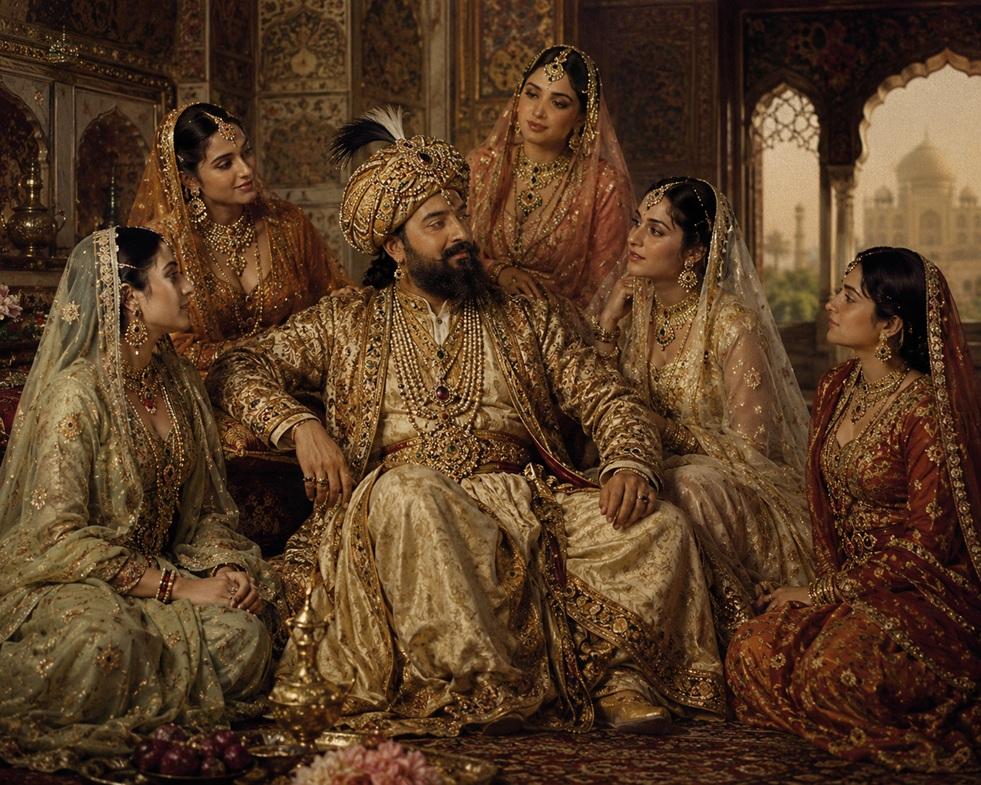
The emperors lived surrounded by gold, perfumes, music, dancing halls, fountains, jeweled thrones and endless celebrations. Their palaces glittered with diamonds from Golconda, carpets from Persia and silks from Central Asia. Royal kitchens prepared hundreds of dishes every day, while massive harems, royal hunts and luxurious festivals became symbols of imperial prestige.

To many foreign travellers visiting India, the Mughal court looked less like a kingdom and more like a world built entirely for pleasure and spectacle.

But this luxury was not only about comfort. It became part of Mughal identity itself.


The Mughal Harem- Luxury Behind the Curtains

(The Mughal harem, also known as the zenana or mahal, was a highly secure, self-contained residential complex that housed the emperor’s female relatives, wives, and concubines (women slaves).

The Mughal harem was one of the most extravagant institutions of medieval India. Contrary to popular imagination, it was not merely a place of confinement. It was a massive royal establishment filled with wives, concubines, princesses, servants, musicians, dancers and female guards.

Some emperors maintained hundreds of women within the royal household. The zenana included luxurious baths, gardens, private markets and entertainment halls.

Royal women wore jewels worth fortunes. Contemporary records describe necklaces of pearls, diamond-studded anklets and dresses embroidered with gold thread.

Even daily life inside the harem reflected excess. Perfumes from Persia, Kashmiri shawls, silk curtains and decorated fountains became part of royal culture.

Yet behind this glamour also existed political influence. Women like Jahanara Begum and Nur Jahan controlled trade, wealth and imperial decisions from inside these luxurious spaces.

Babur: The Warrior Who Wanted Paradise on Earth

Babur came to India as a conqueror in 1526, but even in war, he desired elegance.

In his memoir, the Baburnama, Babur wrote openly about gardens, wine, fruits and poetry. He disliked the harsh climate of India and immediately began constructing Persian-style gardens with flowing water channels and shaded pavilions.

Even during military campaigns, royal tents were decorated richly. Mughal emperors did not separate warfare from luxury; they carried luxury with them.

Babur’s court also included musicians, poets and noble women who actively participated in royal life. The Mughal culture of pleasure had already begun.


Akbar: The Emperor Who Turned Royal Splendor Into Political Theatre

Under Akbar, luxury became imperial performance.

Akbar’s palace at Fatehpur Sikri was designed to display overwhelming grandeur. Foreign ambassadors entering his court witnessed elephants painted with bright colours, nobles wearing embroidered silk robes and ceremonial halls decorated with gold and precious stones.

Akbar maintained an enormous royal household. Historical records from the Ain-i-Akbari mention thousands of women, attendants and servants inside the imperial harem. The Mughal zenana itself functioned like a miniature city with separate quarters, gardens, markets and security arrangements.

The emperor enjoyed lavish feasts, hunting expeditions and musical performances. Court musicians like Tansen performed regularly, while dancers and entertainers became central to royal celebrations.

Akbar also married multiple women, including Rajput princesses, partly for political alliances and partly as part of royal custom. For Mughal emperors, marriages reflected prestige and power.

Yet Akbar balanced pleasure with administration, which is why the empire remained stable despite the enormous luxury surrounding the court.


Jahangir: Wine, Women and the Culture of Pleasure

If Akbar created grandeur, Jahangir openly embraced indulgence.

Jahangir loved wine so deeply that he himself admitted his addiction in the Jahangirnama. European travellers frequently described evenings in the Mughal court filled with drinking sessions, music and luxurious gatherings.

He adored paintings, perfumes, jewels and exotic animals. His private gardens became spaces for entertainment and relaxation, where royal gatherings continued late into the night.

The Mughal harem under Jahangir expanded enormously. Royal women wore expensive jewellry made of emeralds, rubies and pearls, while luxurious fabrics and perfumes became symbols of elite status.

Beside him stood Nur Jahan, perhaps the most glamorous and powerful woman of the Mughal period. She introduced new styles of clothing, perfumes and jewellry into the imperial court. Historical accounts suggest that even the designs of royal dresses changed under her influence.

The Mughal court under Jahangir became a world of refined pleasure, artistic beauty and elite extravagance.


Shah Jahan: The Emperor Who Built Luxury in Marble

No ruler represented Mughal extravagance more than Shah Jahan. His reign was the peak of Mughal wealth and luxury.

The greatest example remains the Taj Mahal, built in memory of Mumtaz Mahal. White marble, precious stones and intricate craftsmanship from across Asia were used to create what became the greatest symbol of royal love and wealth.

But Shah Jahan’s luxurious lifestyle extended far beyond monuments.

His court ceremonies were legendary. The emperor appeared seated on the Peacock Throne, covered with diamonds, pearls, rubies and emeralds. Contemporary travellers described the throne as one of the most expensive objects ever created.

The Mughal kitchens under Shah Jahan reportedly prepared elaborate meals with dry fruits, saffron rice, roasted meats and rich desserts served in gold and silver utensils.

His harem was equally grand. Thousands of attendants, dancers, servants and royal women lived inside luxurious palace complexes with fountains, private gardens and marble chambers.

For the Mughal elite, luxury was not occasional — it was daily life.


Muhammad Shah Rangila: Pleasure While the Empire Declined

The most extravagant among the later Mughals was Muhammad Shah, famously known as Muhammad Shah Rangila.

The word “Rangila” itself means colorful, pleasure-loving and flamboyant.

His court became famous for music, dance performances, mehfils and celebrations that continued despite the empire’s weakening condition. Kathak dance flourished during his reign, and musicians received royal patronage.

Muhammad Shah loved luxurious clothing, perfumes and entertainment. Court life focused heavily on pleasure and celebration, while political discipline declined.

At the same time, nobles fought among themselves, provinces became independent and military strength weakened dangerously.

Then came the disaster of 1739.

Persian ruler Nadir Shah invaded Delhi, looted the Mughal treasury and carried away the Peacock Throne and the Kohinoor diamond. Delhi witnessed violence and humiliation on a massive scale.

The tragedy was symbolic: the empire that once displayed limitless luxury could no longer protect its own wealth.


Why the Mughal Grandeur Could Not Survive - Decline of Luxury

The decline of the Mughal Empire did not happen in a single battle. It happened slowly, like a palace losing its light room by room.

For generations, the Mughal emperors had lived in extraordinary luxury. They ruled from marble palaces, maintained massive harems, celebrated grand festivals and displayed wealth that amazed the world. But such luxury required something very important behind it — a strong empire.

And slowly, that strength began disappearing.

The earlier Mughal rulers like Akbar, Jahangir and Shah Jahan were extravagant, but they were also capable administrators. They expanded trade, controlled rebellious nobles, maintained strong armies and collected enormous revenues from agriculture and commerce.

Their luxury was supported by a stable political system.

But after Aurangzeb, the later Mughal emperors inherited the luxury without inheriting the political skill required to sustain it.

This became the beginning of the collapse.


Aurangzeb’s Endless Wars Exhausted the Empire

One of the biggest reasons behind Mughal decline was the long rule of Aurangzeb.

Aurangzeb spent decades fighting costly wars in the Deccan against the Marathas and other regional powers. These military campaigns drained the Mughal treasury completely.

The empire became too large to control effectively.

Money that once funded magnificent architecture, trade networks and royal administration was now being spent continuously on warfare. Soldiers needed salaries, weapons and supplies. The empire kept expanding geographically, but economically it was weakening from inside.

By the time Aurangzeb died in 1707, the Mughal Empire looked huge on the map, but financially and politically it had become unstable.


Weak Successors and the Crisis of Leadership

After Aurangzeb, the empire faced another major problem — weak rulers.

The later Mughal emperors lacked the leadership of Akbar or the administrative intelligence of Shah Jahan. Many of them became dependent on nobles, court factions and regional governors.

Instead of controlling the empire, they were struggling to control their own court.

The Mughal tradition also created constant succession wars because there was no fixed rule that the eldest son would become emperor. Every prince fought for the throne.

These wars weakened the empire repeatedly.

Brothers killed brothers, nobles changed sides and armies fought internal battles for power. The empire was bleeding itself from within.


Luxury Continued, But the Economy Was Breaking

One of the most tragic parts of Mughal decline was this: even when the empire was weakening, the lifestyle of the court did not change immediately.

Inside Delhi’s palaces, music still played, dancers still performed and expensive celebrations still continued.

But outside the palace walls, the economy was under pressure.

Heavy taxation increased pressure on peasants. Corruption among officials grew rapidly. Provincial governors started behaving like independent kings and stopped sending proper revenue to Delhi.

The Mughal emperors still wanted the glory of earlier rulers, but they no longer had the financial power to maintain it properly.

It was like trying to keep a giant palace shining while its foundations were slowly cracking underneath.


The Rise of Regional Powers

As the Mughal center weakened, new powers began rising across India.

The Marathas became stronger in western India. The Sikhs emerged as an important military force in Punjab. Nawabs in Bengal, Awadh and Hyderabad started functioning almost independently.

The Mughal emperor was still respected symbolically, but real political power was slipping away province by province.

This reduced the empire’s income drastically.

Earlier Mughal rulers had controlled enormous agricultural wealth and trade routes. Now much of that revenue remained with local rulers instead of reaching Delhi.

Without money, maintaining royal grandeur became increasingly difficult.


Nadir Shah’s Invasion: The Moment the Illusion Broke

The real psychological collapse of Mughal grandeur came in 1739 during the invasion of Persian ruler Nadir Shah.

When Nadir Shah attacked Delhi, the Mughal Empire failed to stop him. The capital city that once symbolized global wealth and imperial power was looted brutally.

The Persian army carried away unimaginable treasures, including the Peacock Throne and the Kohinoor diamond.

The streets of Delhi witnessed violence, fear and destruction.

This event destroyed the image of Mughal invincibility forever.

For centuries, the Mughal emperors had projected themselves as rulers of limitless power and wealth. But after Nadir Shah’s invasion, the world realized that the empire was weak.

Even worse, the Mughal treasury never fully recovered from this looting.

The luxurious lifestyle that had once defined the empire became difficult to maintain after such enormous economic loss.


The British East India Company and the Final Blow

While the later Mughals struggled with internal decline, another force was quietly rising — the British East India Company.

At first, the British came as traders. But slowly, they entered Indian politics, formed alliances with local rulers and expanded military control.

The Mughal emperors had become too weak to stop them.

By the late eighteenth century, the emperor in Delhi had become more symbolic than powerful. The royal court still maintained ceremonies and traditions, but actual authority was disappearing.

Finally, after the Revolt of 1857, the British removed Bahadur Shah Zafar, the last Mughal emperor, and ended the Mughal dynasty permanently.

The empire that once ruled India from marble palaces ended in political exile and poverty.


The Tragedy of the Mughal Empire

The decline of the Mughals is fascinating because it was not simply a fall of kings — it was the fall of an entire lifestyle.

For generations, the Mughal emperors lived surrounded by beauty, luxury, music, perfumes and unimaginable wealth. Their courts became symbols of sophistication across the world.

But slowly, luxury turned into distraction.

The later rulers inherited the pleasures of empire without maintaining the systems that supported it. Administration weakened, military power declined and economic foundations collapsed.

The palaces still glittered, but the empire behind them was fading away.

And perhaps that is why the Mughal story still feels so powerful today.

Because it reminds us that no empire collapses suddenly. First, the discipline disappears. Then the treasury weakens. Then power slips away quietly — until one day, only the memories of grandeur remain.


The Real Story of Mughal Extravagance

The Mughal emperors lived lives that most ordinary people could not even imagine.

They ruled from marble palaces, celebrated with music and wine, maintained enormous harems, wore jewels worth kingdoms and transformed luxury into a language of power.

But Mughal history also reveals a deeper truth: excessive indulgence often creates distance from political realities.

As long as strong rulers balanced extravagance with governance, the empire flourished. But when pleasure overtook administration, decline followed.

That is why the Mughal Empire still fascinates modern readers — because it was an empire where beauty and decay, luxury and collapse, pleasure and politics all existed together under the same glittering roof. 


Comments (0)

No Comments Yet!

Please Login to Comment on Article!