

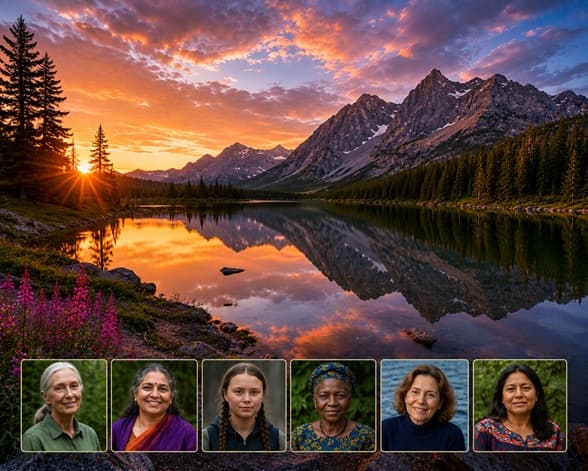
Six Women, One Planet - Stories of Courage Changing the Future of the Earth.

15 May 2026 | 3:16 am
Highlights
- The stories of six women challenge the environmental imbalance and presented an impactful change.
- Why are women, especially grassroots women, often at the forefront of environmental movements?
- Why Poor communities, indigenous groups, women, and children often face the harshest consequences?
- What are the significance of such movements?
- What Can India Learn and what Indian societies can do?
"The greatest threat to our planet is the belief that someone else will save it"
At a time when climate change is no longer a distant warning but a lived reality, the world often looks towards governments, scientists, and global institutions for solutions. Yet, some of the most powerful environmental battles are not being fought inside conference halls or political summits. They are being fought in forests, rivers, coastal villages, mining regions, and indigenous communities — by ordinary women with extraordinary courage.
The 2026 Goldman Environmental Prize, often called the “Green Nobel”, became historic for a reason far beyond environmental recognition. For the first time since the award was established in 1989, all six winners were women. Coming from Colombia, Nigeria, Papua New Guinea, South Korea, the United Kingdom, and the United States, these women stood against powerful industries, legal systems, environmental destruction, and social pressure to protect not just nature, but humanity’s future itself.
Their stories are not merely environmental victories. They are stories of resistance, sacrifice, justice, leadership, and hope. They remind the world that environmental protection is deeply connected with human dignity, indigenous rights, women’s leadership, and intergenerational responsibility.
This historic moment also forces us to rethink an important question: Why are women, especially grassroots women, often at the forefront of environmental movements? The answer lies in the reality that women are usually the first to experience the consequences of ecological destruction — whether through water scarcity, food insecurity, displacement, health crises, or loss of livelihood. Yet despite carrying this burden, women remain underrepresented in climate decision-making and policy spaces across the world.
The stories of these six women challenge that imbalance - Women Who Refused to Stay Silent
Yuvelis Morales Blanco – Protecting the River That Raised Her
Growing up in the Afro-Colombian fishing community of Puerto Wilches, Yuvelis Morales Blanco did not see the Magdalena River merely as water flowing through her village. For her community, the river was life itself — a provider, protector, and source of identity.
Everything changed after a devastating oil spill in 2018 that displaced families and killed thousands of animals. While many remained fearful of powerful oil corporations, Yuvelis chose
resistance. She organised protests, mobilised communities, and brought global attention to the dangers of commercial fracking in Colombia.
Her activism came with threats, intimidation, and even forced relocation. Yet she continued. Her struggle eventually helped halt major projects and transformed fracking into a national political issue during Colombia’s 2022 elections.
Yuvelis’s story shows how environmental destruction is never just about nature; it is about livelihoods, identity, culture, and survival.
Borim Kim – Defending the Rights of Future Generations
In South Korea, Borim Kim transformed youth anxiety about climate change into constitutional action.
Through the organisation Youth 4 Climate Action, she led a historic legal battle arguing that weak climate policies violate the constitutional rights of future generations. Her movement succeeded when South Korea’s Constitutional Court ruled in favour of stronger climate accountability — the first successful youth-led climate litigation in Asia.
This was more than a legal victory. It was a reminder that climate justice is also generational justice. Future generations, though voiceless today, deserve protection from the irreversible consequences of environmental negligence.
Borim’s activism demonstrates the growing role of young women in shaping global climate politics through law, education, and democratic engagement.
Sarah Finch – Fighting Fossil Fuels Through Law
For over a decade, Sarah Finch and the Weald Action Group challenged oil drilling projects in southeastern England.
Her struggle resulted in the landmark “Finch ruling” by the UK Supreme Court in 2024, which declared that authorities must consider the broader climate impacts of fossil fuels before approving extraction projects.
This decision changed the legal landscape of environmental governance in the UK and strengthened the idea that climate accountability cannot remain limited to local consequences alone.
Sarah’s journey highlights how ordinary citizens, through persistence and legal awareness, can challenge systems far more powerful than themselves.
Theonila Roka Matbob – Healing the Wounds of Mining
In Papua New Guinea, the scars of mining were not merely environmental but deeply social and emotional.
The Panguna copper mine, once operated by Rio Tinto, left behind severe environmental destruction and social unrest that continued decades after its closure. Theonila Roka Matbob emerged as a powerful voice demanding accountability and justice for affected communities.
Her efforts pushed one of the world’s largest mining corporations to acknowledge and address the devastation caused by its operations.
Her movement reflects a larger global truth: development without responsibility often becomes exploitation.
Alannah Acaq Hurley – Indigenous Resistance for Ecological Survival
Representing the Yup’ik nation in the United States, Alannah Acaq Hurley fought alongside tribal communities to stop a massive mining project in Alaska’s Bristol Bay region.
The proposed project threatened one of the world’s largest salmon ecosystems and endangered indigenous ways of life rooted in ecological balance.
Her struggle reflects how indigenous communities often become the strongest defenders of biodiversity because their survival is directly connected to nature.
The world increasingly recognises that indigenous knowledge systems are not outdated traditions; they are sustainable models for the future.
Iroro Tanshi – Saving a Species from Extinction
In Nigeria, Iroro Tanshi rediscovered the endangered short-tailed roundleaf bat and began efforts to protect its fragile habitat in the Afi Mountain Wildlife Sanctuary.
At first glance, protecting bats may seem like a small issue compared to global climate crises. Yet biodiversity protection is essential to ecological stability. Every species lost weakens the balance of life itself.
Despite threats like wildfires and habitat destruction, Iroro’s work reminds us that environmental conservation begins with protecting even the smallest forms of life.
Why Does This Moment Matters?
The significance of this year’s Goldman Prize lies not only in environmental activism but also in representation.
For centuries, environmental decisions were dominated by political and industrial elites. Women, indigenous communities, local farmers, and tribal populations were rarely included in policy conversations despite being the most affected.
These six women challenge that pattern. Their victories prove that leadership does not always emerge from positions of power. Sometimes, it emerges from lived experience, moral courage, and an unwillingness to accept injustice.
The all-women cohort also symbolises a larger transformation taking place globally — the rise of women-led climate justice movements.
Lessons the World Must Learn
1. Environmental Justice is Social Justice-
Climate change affects everyone, but not equally. Poor communities, indigenous groups, women, and children often face the harshest consequences despite contributing the least to environmental destruction.
Environmental policies must therefore focus not only on conservation but also on fairness, equity, and dignity.
2. Grassroots Voices Matter-
Many of the world’s strongest environmental movements began not in parliaments but in villages, forests, and local communities.
Governments and global institutions must include local voices in climate governance rather than treating development as a top-down process.
3. Women are Not Just Victims — They are Leaders
Women are frequently portrayed only as victims of climate crises. These stories challenge that narrative.
Women are organisers, defenders, negotiators, scientists, lawyers, educators, and protectors of communities. Climate leadership must therefore become more gender-inclusive at every level.
Indian Context: What Can India Learn?
India too has witnessed powerful women-led environmental movements.
The Chipko Movement saw rural women in Uttarakhand hugging trees to stop deforestation. Activists like Medha Patkar raised their voices against displacement caused by large dam projects. Countless tribal and rural women continue protecting forests, water sources, and local biodiversity even today.
However, women in India still face barriers in land ownership, climate decision-making, scientific representation, and policy leadership.
India can learn important lessons from global women-led environmental activism by:
• Increasing women’s participation in climate policymaking
• Supporting rural and indigenous women leaders
• Strengthening environmental education in schools and colleges
• Encouraging youth activism and legal awareness
• Promoting sustainable local economies led by women
• Ensuring environmental impact assessments genuinely include affected communities
What Can Society Do Today?
True environmental change cannot happen only through laws or international agreements. It must begin within society itself.
At the Family Level
Families must teach children respect for nature, gender equality, and social responsibility from an early age.
At the School Level
Environmental education should move beyond textbook learning and encourage critical thinking, sustainability projects, and climate awareness.
At the College Level
Universities should support climate research, youth-led activism, innovation, and women’s leadership programs.
At the Government Level
Policies must prioritise renewable energy, indigenous rights, ecological accountability, and climate justice.
At the Global Level
The world must shift from exploitative development models toward sustainable and inclusive growth.
The stories of these six women are not simply stories of environmental activism. They are stories of humanity standing at a crossroads.
In a world driven by profit, extraction, and unchecked industrial expansion, these women chose courage over silence. They defended rivers, forests, wildlife, indigenous identity, and future generations — often at great personal cost.
Their journeys remind us that protecting the Earth is not merely an environmental responsibility; it is a moral responsibility.
The future of the planet will not be saved by technology alone. It will also be saved by empathy, justice, courage, and the willingness of ordinary people to stand against extraordinary odds.
And perhaps the greatest lesson these women teach us is this:
Real change begins when even one voice refuses to surrender.
Comments (0)
No Comments Yet!
Please Login to Comment on Article!